Have any question? Call Us Now?

Stem Cell Treatment for Retinitis Pigmentosa: What It Is, Who Is Evaluated and What to Expect - Eye Stem Cell Center
October 27, 2026/ 0 comment
Stem Cell Treatment for Retinitis Pigmentosa: What It Is, Who Is Evaluated and What to Expect
Last updated: 27 October 2026 | Author: Prashant Tyagi (Stem Cell Biotechnology Specialist, 10+ years) and Dr. Pallavee Senior Consultant | Ophthalmologist & Eye Surgeon 22+ Years Experience
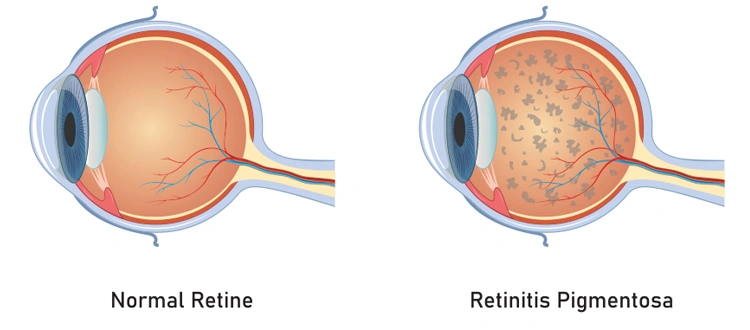
Retinitis pigmentosa (RP) is a group of inherited conditions in which the light-sensing cells of the retina gradually stop working. Night vision is lost first, then the side vision narrows, and in some people central vision is affected later. Families naturally ask whether stem cells can help. This article explains the science honestly, what an evaluation involves, and what realistic goals look like.
Important: Stem cell treatment for RP is investigational. It is not a cure, it cannot bring back vision that is already lost, and outcomes cannot be guaranteed.
What Is Retinitis Pigmentosa?
RP is caused by changes in genes that keep rod and cone photoreceptors healthy. Rods, which handle dim light and peripheral vision, are affected first, which explains the typical pattern of night blindness followed by tunnel vision. RP can occur alone or as part of a syndrome such as Usher syndrome. For a broader look at related conditions see our page on retinal dystrophy treatment.
Symptoms and Progression
| Stage | What patients notice |
|---|---|
| Early | Difficulty seeing at night or in dim rooms, slow adjustment from light to dark |
| Middle | Narrowing of side vision, bumping into objects, trouble with glare |
| Advanced | Tunnel vision, reduced central clarity, difficulty reading and recognising faces |
Standard Care Today
- Genetic testing and counselling to identify the gene and inheritance pattern
- Gene therapy: approved only for a small group with changes in both copies of the RPE65 gene
- Treating complications such as cataract and macular swelling
- Low-vision aids and rehabilitation, orientation and mobility training
- UV protection and regular monitoring with a retina specialist
Nutritional supplements should only be taken on a specialist’s advice, because some can be harmful in certain forms of retinal disease.
How Stem Cells Are Being Explored
| Approach | Idea | Status |
|---|---|---|
| Mesenchymal stem cells (MSCs) | Release protective and anti-inflammatory factors that may support remaining photoreceptors | Early-phase studies; protocols vary |
| Retinal pigment epithelium (RPE) cells | Replace supporting cells under the retina | Clinical trials in selected retinal diseases |
| Photoreceptor precursor cells | Replace lost light-sensing cells | Largely laboratory and early trial stage |
You can browse registered trials at ClinicalTrials.gov and the Clinical Trials Registry of India before deciding. Our own service page for stem cell treatment for retinitis pigmentosa explains the evaluation we offer.
Realistic Expectations
- The most reasonable goal is to support remaining function and possibly slow progression, not to restore normal sight.
- Photoreceptors that have already died cannot be revived by MSC therapy.
- Response differs between individuals and between genetic types.
- Regular follow-up testing (visual fields, OCT, ERG) is the only reliable way to judge benefit.
Who May Be Evaluated?
| Situation | Typical approach |
|---|---|
| Confirmed RP with measurable remaining vision or field | May be evaluated after reports are reviewed |
| Macular swelling or cataract not yet treated | Treat these first with your retina specialist |
| No light perception | Expectations should be very limited; individual opinion only |
| Active eye infection or uncontrolled systemic illness | Not suitable until resolved |
Reports to Share
- Visual field (perimetry) and OCT reports
- ERG report, if available
- Genetic test report, if done
- Diagnosis summary and treatment history
- Recent best-corrected visual acuity
Evaluation Process
- Report review and initial opinion
- Consultation and counselling on goals and limitations
- Baseline tests: acuity, fields, OCT
- Treatment planning only if you are found suitable
- Scheduled follow-up testing, coordinated with your own eye doctor
Risks and Limitations
- No guarantee of improvement; some patients notice no change.
- Possible discomfort, redness, inflammation or infection linked to the procedure.
- Therapy is investigational, so it is usually not covered by insurance.
Frequently Asked Questions
Is there a cure for retinitis pigmentosa?
No cure exists yet. Gene therapy is available for a small group, and research on cell-based and other approaches is ongoing.
Can stem cells restore night vision?
There is no proof of this. Stem cell research aims mainly to protect remaining cells and slow decline.
Which type of RP responds best?
This is not yet known. Patients with more remaining retina generally have more to protect.
Should I get genetic testing first?
Yes, genetic testing is recommended because it may point to eligible gene therapy or clinical trials and helps family planning.
How long does the evaluation take?
Report review is quick; if you travel for evaluation, plan about a week.
Is RP the same as Usher syndrome?
Usher syndrome combines RP-type vision loss with hearing loss; many RP cases have no hearing problem.
Official References
- National Eye Institute: Retinitis Pigmentosa
- American Academy of Ophthalmology: Retinitis Pigmentosa
- Foundation Fighting Blindness
- ClinicalTrials.gov
- Clinical Trials Registry, India (CTRI)
- ISSCR: A Closer Look at Stem Cells
Related Readings
Disclaimer: This article is for information only and is not medical advice. Stem cell treatment for retinitis pigmentosa is investigational and results are not guaranteed.
